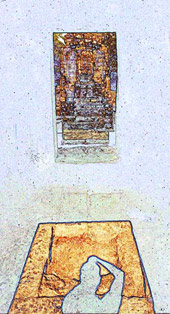
Yin and Yang

This image of Buddha is symbolic of heavenly ideals. The shadow of the photographer is represntative of earthly pursuits.

ANGKOR WAT, CAMBODIA.


Digital photography


Ngeow Voon-Chin, MALAYSIA

 
  Photography had always seemed to maintain a rather dubious position in the world of art. Most artists, while reluctant to deny photography its place in the art world , often do not talk about it in the same breath. The greatest strength of a camera is its ability to capture a moment in time. With improvements in photographic processing and darkroom techniques over the years, photographers were more able to exploit the medium and use it increasingly for artistic self expression . However , conventional techniques have its limitations and placed constraints on creativity.
 

Digital technology can now equip the photographer with a powerful tool offering unparalleled creative freedom. Given the pace of development of digital imaging,the skilful application of this medium hopefully will propel photography closer to the true realm of art.
 

A conventional camera captures the images and records them onto silver ó based films, whereas a digital camera converts visual information into electronic signals using tiny arrays of light sensitive sensors called CCD ( charged ó coupled devices ).

One can do very little in making alterations to images from films. However the digital signals of an image when fed into a computer can easily be processed in numerous ways ó whether to enhance or to alter or delete any undesirable elements in any picture according to the photographerís interpretation.

Conventional darkroom techniques had always been employed to improve the quality of an image using such devices as filters, dodging and burning, and chemical treatments such as solarisation, and monochrome inversions. The clear advantage of digital technology is that it can replicate most of these effects and more. Besides this, the dream of the ultimate digital darkroom is now a reality.

Most of the time a photographer do not have total control over the whole process from taking a picture to the final output ó a photographic print. For most of us, after taking a picture we depend on the skill of others to process and develop our films and prints. Often the photo lab people do not know exactly the photographerís requirements and the end result is prints that are unsatisfactory or mediocre. One can now shoot a picture with a digital camera, feed the stored images into a computer, carry out adjustments or enhancements to the images according to oneís interpretation and then output it through a printer as a photographic print . This is total control of the whole photographic process.
  In theory , images taken via a digital camera can produce better quality pictures .The dynamic range ( the range of light intensities that can be recorded ) of a good quality digital camera is at least twice that of a conventional camera recording onto film negatives.
  Another advantage is that the technology is constantly evolving and improving both in terms of equipment costs and quality. Five years ago, a typical digital photo was processed with 8- bit computers and had only 256 colour shades to each picture element ( pixels ). The resolution was so low that image edges appeared jagged and certainly quality - wise was not up to professional standards. Today a mid-price digital camera is capable of resolutions that surpass the negative film of typically 1000 dpi ( dots per inch). The colour depth of a 24- bit digital camera can record 16.7 million shades of colours. Cameras with 32 ó bit colour depth are currently available capable of displaying the minutest difference in shades not possible with conventional cameras shooting with negative films.
   

Nevertheless one ought not to be carried away by all these technical innovations. Digital technology still remains very much a tool. Whether a picture is rendered well or poorly lies in the skills of the photographer. It does not matter if one employs conventional methods or digital techniques or even Vaseline to achieve oneís objectives.
   

The next millennium will certainly see digital photo art ó for want of a better name , increasingly making its presence felt in the world of photography. Photographers who have artistic inclinations will find digital imaging add new dimensions to their work without sacrificing existing standards.
   

Photography as we know it will never be the same again


Mr. Ngeow Voon-Chin, MALAYSIA

Personal file :


Mr. Ngeow Voon-Chin is a Chartered Civil Engineer ( U.K.) , and a registered Professional Engineer, Malaysia.

Business: Property Developer
Experience : Interested in photography since 1990.
Special interest : Digital & Travel Photography
Photo Club : Vice-President Photographic Society of P.Jaya. 97/98

Exhibition: Held first ever " Digital Photo Art " Exhibition together with Mr.K.S.Chuah at Sunway Pyramid in Aug 99 in aid of National Stroke Association, Malaysia.

Philosophy: Photography is a medium of expression which can be channelled for many purposes. .One can use it to express oneself; share thoughts with others; earn a living with it. Of course, record history with it. All these are very satisfying experiences, and I am glad , taking up photography had enabled me to experience some of these moments.To be able to help the less fortunate by raising funds for charity by contributing our pictures, for me is the most satisfying. 

| C L O S E |


[Left Brain][Potpourri[Right Brain][MIR Home][Art & Design][Collectibles][Clubs][Portfolios][Camera Shops][Suppliers][On Assignments][Pix of the Week][Trading Room][Knowledge & Resources][Free-Trade-Zone][Thoughts & Opinions][Links]

Copyright 2000 ©. Web design by MC Lau. All Rights Reserved.Created with an iMac. Serves with a RedHat Linux powered server.