
...continued from page 4
You love the radio. What kept you going?
Patrick: Like I said, what keeps me going is my love for the medium and my love for
talking to people; and getting into arguments and debates. Just communicating with
people. What other jobs give you this kind of opportunity? There is nothing I like
better than to sit around to talk to other people and argue and debate.
A lot of people have this misconception that I have worked with Radio 4 for a very
long time. Actually, I haven't. I only started doing live radio (with Radio 4) on
July 4, 1994. Prior to that, I was just doing Redifussion which has very limited
reach and just did pre-recorded shows like Kee Huat Fantastic Facts and Fancies,
and that just happened to be broadcast on Radio 4. These were shows that were pre-recorded
and my sponsors took them to radio stations.
What role do you see for yourself in radio?
Patrick: If at the end of the day, I can say to myself, I have succeeded to a certain
extent in bringing people together and who are willing to talk to each other without
stabbing each other in the back. A lot of people, when I started this talk show,
they called me rude, obnoxious, blah, blah, blah, and they tell me it is not the
Malaysian way. Malaysians don't do things like that, we're not rude to people. My
question to these people is: what is the Malaysian way? Is the Malaysian way to smile
when you are facing somebody and stab him in the back once he turns around. Is that
preferable? To say what you don't mean, is that preferable?
For many, many years, Malaysians have been: "Eh, come-ah my house next weekend
for lunch?"
"Ah, sure-sure, okay-okay."
Then he won't show up. Is that Malaysian? Is that preferable to saying, "No,
I don't think so. Thanks for the invitation but I am not coming."
How many times have you organised parties and all that. "Please RSVP by Friday."
Nobody does it. Is that Malaysian?
If you read the papers, and if you listen to my programme, people complain: "You
are this and that. How can you cut people off, you should give people a chance to
talk?" My answer to you is: If you have nothing to say, why should you waste
my time. You know that you are going to ring me up, so get prepared. Call me up,
I will give you the airtime, say whatever you want to say. Don't call me up and say,
"What is the topic for today?" If you don't bloody know, don't call. You
are wasting my time. If you have nothing to add, just listen, don't call.
If you have a free hand to achieve this role of yours---bringing people together
to talk frankly without back-stabbing one another---how would you do that? Today,
on the radio, you just don't have the freedom to do that.
Patrick: Hmm, if I had a free hand, what would I do? (pause) If I ran a radio station,
I would have a station that is non-political, non-sexual, non-religious, non-racial;
just to get people to talk about things that affect them in their daily lives. It
could be about whether the bus fare should be increased, why it shouldn't be increased,
blah, blah, blah. Get people to talk and realise what their rights are within the
perimeters of the government of course.
Then, that's political.
Patrick: In a way it is, but I'm not going to say that the government is wrong doing
this. I am not going to champion any causes, you know, because in a country like
ours, that would not be possible. But other than that, there are many other ways
that people can still voice their problems. And it has been proven that in certain
cases that it has worked.
Okay, I don't know if it actually happened, but my run-up with the police. Could
it have been the catalyst for what the police are doing now? It may not last for
very long, I don't know. But at least, because this thing happened, something positive---not
100 percent---but something positive has come out of it. People are listening thinking
that we must do something about it.
Could that be tied up to what is happening now?
Patrick: Up until today, they have not told me what they are going to do. There is
a police report that has been lodged at the Damansara police station against me for
criminal defamation. They have completed or are in the process of completing their
so-called investigation, and they have not yet told me what they intend to do.
You have been somewhat critical of what Malaysians are like now. What are some
of the positive things that you can say about being Malaysian?
Patrick: I think one of the positive things that we can look at is that what
we are going through is merely a stage of natural progression. We have come from
an era of total racial harmony to slight racial disharmony. Now, we are going back
to racial harmony with the accompanying economic boom time. We are finding people
who are too money conscious, and not bothered about developing other aspects of their
personality. But I think it is merely an act of natural progression. After this,
we will get to another level where we will be more matured as a society. I don't
believe in other dissidents who say that we are heading into a big pit in the ground.
I think every country needs to go through this phase.
And you think we are progressing at a healthy pace?
Patrick: Hmm, not necessarily at a healthy pace. I would like to see it accelerated
a little bit more; but we are at least moving in the right direction.
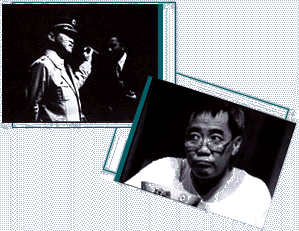
You have acted in a few plays. Tell us a little about it.
Patrick: I have always been interested in acting. I had my first role about six or
seven years ago when I was offered a cameo role in a play called A Man for All Seasons.
Since then, I have acted in seven plays---only one was a major role, the rest were
all cameos. I have just been offered another role that Instant Cafe Theatre is going
to put on later in the year. I have done one television drama, and two television
comedies. But I have no big hope for a career in acting. I have to face facts also---not
many roles are written for ageing DJs pushing 50. So you always get cameo roles playing
somebody's father or uncle, or a crooked contractor.
Between that (Kee Huat's Fantastic Facts and Fancies) and July 1994, there was
a very long hiatus.
Patrick: That was not self-imposed. During that period, there was a lot of things
happening on radio. There was a period of time when radio refused to have any part-timers
in their schedule. That went on for quite some time.
How long was the hiatus?
Patrick: About ten years.
That was when you read news for TV.
Patrick: Yes, for TV3. For three years.
Why did you stop?
Patrick: I got fired. Well, in a way. One day, they told me that they don't need
me anymore. As a part-timer, that was how it was.
No reasons?
Patrick: Well, one of the editors said, "Come on-lah Patrick. You are an old
hand in this. You don't need the money or the publicity anymore. Give other people
a chance-lah." That was one reason I was offered. The other reason I was offered
was: "We don't need part-timers anymore-lah because we are developing our own
people."
People like us have no recourse to argue one-lah. Like this Radio 4 thing, if they
don't put me back on the schedule, that's the end of it. I can't go ask them for
a reason. And they are not required to give one. This is again, the studio system.
Tell us about Patrick Teoh and family.
Patrick: I have two girls aged 21 and 25. And I have been separated from my wife
for many, many years (17 years).


other people | the full story | top | main | potpourri | back to mir