NOT ready
YET
500mm
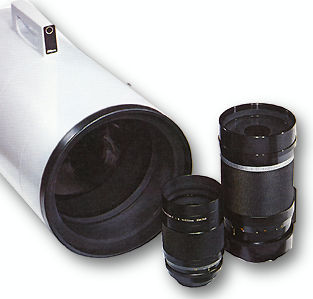
f/8. 1000mm f/11, 2000mm f/ 11 Reflex-Nikkors Reflex-Nikkors are a combination of
mirrors and lens elements designed on the catadioptric (mirror-reflex) principles
used in large astronomical telescopes. Unlike conventional lenses, in the reflex
lenses incoming light bounces back and forth on mirror surfaces, resulting in extensive
reduction in lens size and weight compared with other lenses of like focal lengths.
Another characteristic of a mirror-reflex lens is that chromatic aberration is virtually
non-existent, eliminating the need for refocusing in infrared ph otography. As no
diaphragm can be incorporated in reflex lenses, exposure is controlled by means of
the shutter speed of the camera or by neutral density or other filters. The doughnut-shaped
blurs of the out-of-focus areas of pictures are a characteristic of reflex lenses
and taking advantage of them can produce interesting effects. The compact 500mm f/8
Reflex-Nikkor is only 14cm long (5-1/2 in) - less than one-third its focal length–
weighs 1 kg (2 lb 3 oz) and can be easily carried for sports, mountain or wildlife
or news photography. It focuses down to 4m (13 ft), very close for its focal length.
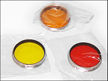
39mm filters can be attached to its rear end. The 1000mm f/11 lens measures 24cm
(9-3/8 in) or less than one-fourth the focal length, and weighs only 1.9kg (4 lb
3 oz), and provides portability and mobility. And with its powerful telephoto effects,
this lens is indispensable for outdoor sports, wildlife, mountain and solar photography.
Closest focusing distance is 8m (25 ft). Four interchangeable filters are included
in a rotating filter wheel built into the rear of the lens. The longest of all the
Nikkor telephoto lenses, the 2000mm f/11 Reflex-Nikkor offers magnifications 40 times
that of the normal lens and is used under special photographic situations. It is
an invaluable lens for close-up coverage of subjects that are so far away that they
are invisible or barely visible to the naked eye. The iens comes with four built-in
filters on a rotatable turret. The carrying handle incorporates a peepsight to help
the photographer pre-spot his subject. As this lens is very heavy (1 7.5kg, 38 lb
9 oz), the use of the AY-1 mounting will facilitate lens manipulation.
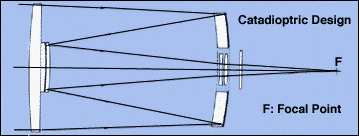 |
A combination
of mirror and lens elements, the catadioptric design is used in Reflex-Nikkor lenses.
Incoming light is reflected twice on mirror surfaces, making the lenses compact and
lightweight in comparison with long telephoto lenses of equivalent focal lengths.
The focused image this design delivers is good in sharpness because of the use of
reflecting surfaces which minimize chromatic aberration. Out-of-focus subjects appear
as blurred rings or as separated blurred lines.
|
| Click on thumnails below to see enlarged
views |
Reflex-Nikkor lenses - 500mm, 1000mm and 2000mm in focal length - are a combination
of mirror and lens elements. They are based on design principles used in large astronomical
telescopes. Incoming light is reflected twice on the mirror surfaces, resulting in
compactness of the lens barrel and light weight relative to their focal lengths.
The physical lengths of these lenses are less than half of their focal lengths.
The 500mm f/8 Reflex-Nikkor weighs about 1kg, the 1000mm 1.9kg and the 2000mm 7.5kg.
These lenses are effective for scientific applications, sports, natural life and
in isolating architectural details. To adjust image brightness, neutral density or
other filters are used, because the Reflex-Nikkor lenses are not equipped with diaphragms.
To compensate for minute displacement of focus caused by temperature changes, the
focusing ring on each Reflex-Nikkor lens may be turned beyond the infinity marking.
Sharpness of the focused image is unsurpassed because of the use of reflecting surfaces
which do not cause any chromatic aberration. This eliminates the need for the infrared
mark on the focusing distance scale. Taken with this type of lens, the subjects in
the out-of-focus range may appear as blurred rings or separated blurred lines.
| Message Board |
for your
Nikkor
Optics
in a shared environment
| Message Board | Specifically for Dispose or Looking for new/used Nikon/Nikkor photographic equipment
Nikon MF RF-Nikkor lenses for Rangefinder
cameras:-
Main Index Page
Nikon
Auto Focus Nikkor lenses:- Main
Index Page
Nikon
Manual
Focus
Nikkor lenses:-
Fisheye-Nikkor Lenses - Circular |
Full Frame |
Ultrawides Lenses - 13mm15mm18mm20mm |
Wideangle Lenses - 24mm28mm35mm |
Standard Lenses - 45mm 50mm 58mm | Telephoto Lenses
- 85mm105mm135mm180mm & 200mm |
Super-Telephoto Lenses - 300mm 400mm 500mm 600mm 800mm 1200mm |
MF Zoom-Nikkor Lenses: 25~50mm | 28~45mm | 28~50mm | 28~85mm | 35~70mm | 36~72mm E | 35~85mm | 35~105mm | 35~135mm | 35~200mm | 43~86mm | 50~135mm | 50~300mm | 70~210mm E | 75~150mm E | 80~200mm | 85~250mm | 100~300mm | 180~600mm | 200~400mm | 200~600mm | 360~1200mm | 1200~1700mm
Tele-Converters: TC-1 | TC-2 | TC-200 | TC-201 | TC-300 | TC-301 | TC-14 | TC-14A | TC-14B | TC-14C | TC-14E | TC-16 | TC-16A | TC-20E
Recommended links to understand more technical details
related to the Nikkor F-mount and production Serial Number:
http://rick_oleson.tripod.com/index-153.html by: my
friend, Rick Oleson
http://www.zi.ku.dk/personal/lhhansen/photo/fmount.htm by: Hansen,
Lars Holst
http://www.mir.com.my/rb/photography/hardwares/nikonfmount/lens2.htm
http://www.photosynthesis.co.nz/nikon/serialno.html
Recommended Reading
Reference on
Nikon cameras and Nikkor lenses
| about
this photographic
web site
 |
| Back | Main
Index Page of Nikkor Resources | Back |
Main Index
Page of Pictorial History of Nikon SLRs |
 |
|
Home - Photography in Malaysia |
 Co-developed
with my web buddy, Rick Oleson® &
Co-developed
with my web buddy, Rick Oleson® &  Denmark, Creator of the Nikon
Repair Group Mailing-List;
A
contributing effort to Michael Liu's Classic Nikon SLRs and
Nikkor optic site.
Denmark, Creator of the Nikon
Repair Group Mailing-List;
A
contributing effort to Michael Liu's Classic Nikon SLRs and
Nikkor optic site.
Credit: MCLau®, who has helped to rewrite
some of the content appeared this site. Chuck Hester® who has been helping
me all along with the development of all these Nikon websites; Lars Holst Hansen, 'Hawkeye'
who shares the same passion I have; Ms Rissa, Sales manager
from Nikon Corporation Malaysia for granting permission to use some of the official
content; Ted Wengelaar, Holland
who
has helped to provide many useful input relating to older Nikkor lenses; Some of the references
on production serial numbers used in this site were extracted from Roland Vink's website; Hiura Shinsaku from Nikomat
Club Japan. Lastly,
to all the good people who has contributed their own expeience, resources or kind
enough granted permission to use their images of their respective optic in this site.
It is also a site to remember a long
lost friend
on the Net. Note:certain content and
images appeared in this site were either scanned from official marketing leaflets
& brochures published by Nikon and/or contribution from surfers who claimed originality
of their work for educational purposes. The creator of the site will not be responsible
for may discrepancies arise from such dispute except rectifying them after verification. "Nikon", "Nikkormat", "Nippon Kokagu
KK"
& "Nikkor" are registered
tradename of Nikon Corporation Inc., Japan. Site made with an Apple IMac.