 |
The Nikkor 50mm f/1.2s has the fastest lens speed among ALL manual focus lenses in the Nikkor lens family.It was the fastest standard MF lens among the FOUR 50mm Nikkor lenses, 50mm f/1.4s, 50mm f/1.8s and Series-E 50mm f/1.8s. It replaced the long serving Ai-Nikkor 55mm f/1.2 standard lens which was introduced way back in 1976. |
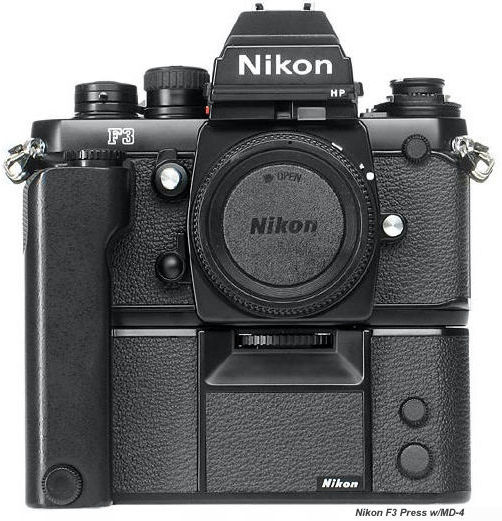
| The Nikon F3was the third generation of the professional class Nikon F-series 35mm SLR camera model. Introduced in 1980, it was the successor to the original Nikon F of 1959, and the hugely successful Nikon F2 of the '70, where both the earlier models were commanding a distinctive supremacy in the professional users' market. When the F3 was first announced, the heavy automation in the camera sent cold shivers down the spine of most purist photographers. As one can still recall, the price of a discontinued fully mechanical Nikon F2AS had a retail price higher than that of a new automatic Nikon F3 during those early days of its introduction, which was Nikon's way of saying 'move on', to the photographic community ! |
 |
|
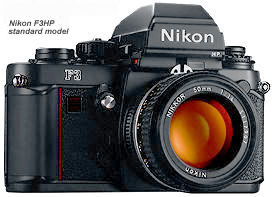
| One important aspect in the design of this classic Nikon is that it replicated the successful concept of mudularity, similar to the previous F and F2. With a modular body design, the F3 was enabled to accept a multitude of dedicated components and accessories to cater to individual requirements and specific photographic needs. The Nikon F3 had the most extensive collection of system accessories built around a body, which has made the F3 one of the most desirable system cameras in the market, by professional users, with many still employed as front line equipment to this day. The first auto focus Nikon SLR was born out of the basic design of the Nikon F3, when in 1983, a Nikon F3 AF, with two dedicated AF-Nikkor lenses, was introduced to showcase Nikon's first entry in the AF technology race to perfection. The F3AF was 3 years ahead of Nikon's first fully integrated AF body design, the Nikon F-501 of 1986, and 5 full years ahead of the professional class series Nikon F4 of 1988 ! One can now instantly recognize the unique "Nikon flavour" of all subsequent body offerings, originally adopted in the Nikon F3, making it the first camera body to depart from conventional oriental design. |
 |
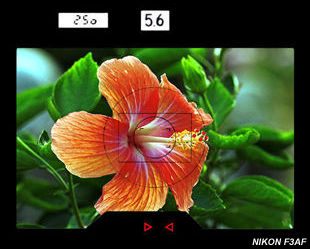 |
<<<---The viewfinder of standard Nikon F3 Series models and alternate autofoccus Nikon F3 AF use a FIXED matte type screen type built directly underneath the DX-1 finder, with viewfinders other than DX-1, more than 20 other types of interchangeable screens are available. |
| The Nikon F3AF, with its dedicated AF optics and removable AF-prism, that can also serve as an electronic range finder to provide visual focusing indication when fitted on any F3 camera (except F3P, F3H and F3 Limited where all came with a non standard DE-5 prism), moved the ball distinctively further down the evolutionary trail. The Nikon F3 series has the most variant models among all single digit professional F models. Strangely, unlike many other competing professional SLR cameras of the time, the feature that contributed to its popularity was its bare basic simple exposure mode of aperture priority AE while maintaining full manual exposure control. Most professionals never got around to turning the shutter speed dial to 'A' and used the F3 in manual mode 100% of the time. The F3 was never intended to be "the greatest thing since sliced bread", instead it was designed to shine in functionality - its strength being realized over time. Soon photographers started to appreciate the level of versatility and hence what a great camera it truly was. I think most of the credit has to be given to its creator, while I personally believe the Company had shown a lot of courage in deciding the specifications, by turning their top of the line reference professional SLR model toward full-automation (well, almost..because the F3 has a mechanical backup shutter even if the batteries failed and with a superior MD-4 Motor Drive that supports its power management). This was an important feature during the early '80, the market was still very much dominated by traditional mechanical battery free manual cameras and users. Competition was keen from rivalling brands where we saw the likes of the Canon New F-1 and Pentax LX that debuted after the Nikon F3 (and other great SLR bodies such as Contax RTS II or even the Olympuses). All of these benefited directly as well as indirectly by the decision of Nikon to stamp a mark of excellence, and thus confidence, on the electronic SLR camera for real life professional usage. |
 |
Regardless for professional applications such as news, reportage, sports, scientific research, journalism and/or simply for leisure, travel or personal photography, Nikon F3 has been serving a few generations of Nikon photographers faithfully and reliably. |
| Strangely, despite most of the
rivalling labels offering richer feature sets in comparison to the F3, the F3's status
was never truly challenged, even after 20 plus years of product cycle.
The Nikon F3 was, and still is, very much in demand. It was the only Nikon professional
F series (single digit)
model that co-existed
with, and survived beyond, the successor professional model Nikon F4, which was intended to replace it. In fact, many of its variants have developed as collectors' favourites. Other than the bare basic camera body which has so much to offer in strength, and for users to explore its potential as a reliable imaging tool, it marks an important point on the development curve of both SLR camera design as well as modern photography. The Nikon F3 was the first professional SLR camera that has truly bridged between mechanical and electronic engineering in camera design, where it spearheaded popular adoption of automation in photographic usage. Its strength and reliability have influenced even the most hard-core users of mechanical SLRs in accepting the fact that automation was an inevitable route to modern photography, without the expense of sacrificing reliability. But most of all, the simplicity in its design and handling, along with an unsurpassed ruggedness, efficiency and great system compatibilities, has made this Nikon body widely acclaimed as a true classic camera of modern times ! This site, along with many other classic SLRs featured in this site, chronicles yet another photographic legend from Nikon. |
| History, Background / Other Issues (8 parts) |
|
 |
 |
Variants
:- Prototypes 1974 | 1977 | Nikon
F3HP
| Nikon
F3AF
| Nikon
F3 Press
| Nikon
F3/T (Titanium)
| Nikon F3 High Speed Motor Drive Camera | Limited Edition Models:- Index Page | Nikon F3 Limited | Nikon F3/T Classic | Nikon F3 Oxberry Pro 5 | Nikon/Kodak F3 Digital DSU | Nikon F3 US Navy Model | Nikon NASA 250 Nikon Speedlights (flash) Models: Index Page Eyes of Nikon:- Rangefinder (RF) Nikkor lenses | Manual Focus (MF) Nikkor lenses | Autofocus (AF) Nikkor lenses Index Page:- Pictorial History of Nikon cameras |
Message Board for your favourite Nikon F3 Series SLR models
Message Board for your Nikkor Optics in a shared environment
MessageBoard Specifically for Disposing or Acquiring Nikon/Nikkor Photographic Equipment
 |
Nikon F | Nikon F2 | Nikon F3 | Nikon F4 | Nikon F5 | Nikon F6 | Nikkormat / Nikomat | Nikon FM | Nikon FE/ FA | Nikon EM/FG/FG20 | Nikon Digital SLRs | Nikon - Other models |
 |
Home - Photography in Malaysia | About this photographic site | Contributions and Credits. in particularly, Mr. Allan M. Purtl who has helped to clean up my poor writing as well as rearranging the site indexes. |