 |
Flash Synchronization Functions |
 |
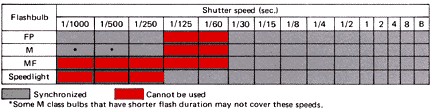
With the vertically traveling focal-plane shutter, the camera has the capability to synchronize with electronic flash units at speeds up to 1/125 second (average according to modern standards), as well as with bulb flash units at almost all shutter speeds (This is the part that I am talking about, although this may not be popular, but lately there is a revised interest because, just like valve tubes in high-end HiFi, there is just a little that the transistors cannot substitute: the warm ambiance, in this case, the bulb's nature in providing even luminiscence and distribution of more natural lighting is hard to duplicate by electronic flash). |
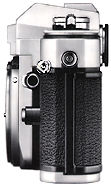
Shown here is the Nikkormat EL2 with Nikon Speedlite SB-3
The EL2 advantage is that it also
features an automatic MX synchronization switchover mechanism which
selects the proper synchronization timing as the shutter speed is set. This automatic
function offers greater convenience and fewer erroneous flash operations.
Hot-shoe Contact. The EL2 is fitted with a fixed accessory
shoe on top of the pentaprism housing, thus offering a convenient flash unit mounting
position. Electrical connection between the flash unit and the camera is achieved
by either of two methods. The electrical contact built into the shoe provides for
direct synchronization with all electronic or bulb flash units fitted with an ISO-type
'hot-shoe' contact: simply slide the unit in place, and it's ready to go.
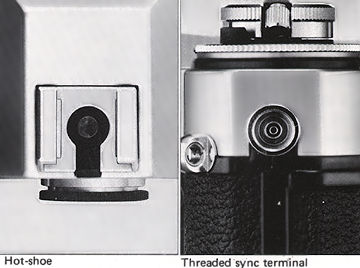 |
Sync Terminal. |
The actual correlation between shutter speed and flash synchronization is illustrated in the chart.
Basic Operation | Shutter Mechanism | Lens Mount
| Exposure
Control | Viewfinder
info | Metering | Flash | Film Advance
(Auto) / Transport
|
Back |
to Index Page of Nikkormats EL2
| Back | to
Main Index Page of Nikkormats EL Series
|
Back | to
Main Index Page of Nikkormat/Nikomat
 |
The Eyes of Nikon:- |
Fisheye-Nikkor Lenses - Circular | Full Frame | Ultrawides Lenses - 13mm15mm18mm20mm | Wideangle Lenses - 24mm28mm35mm |
Standard Lenses - 45mm 50mm 58mm | Telephoto Lenses - 85mm105mm135mm180mm & 200mm |
Super-Telephoto Lenses - 300mm 400mm 500mm 600mm 800mm 1200mm |
Special Application lenses:
Micro-Nikkor Lenses - 50mm~55mm -60mm 85mm -105mm 200mm Micro-Zoom 70-180mm
Perspective Control (PC) - 28mm 35mm PC-Micro 85mm
Dedicated Lenses for Nikon F3AF: AF 80mm f/2.8 | AF 200mm f/3.5 EDIF
Depth of Field Control (DC): 105mm 135mm
Medical Nikkor: 120mm 200mm
Reflex-Nikkor Lenses - 500mm 1000mm 2000mm
Others: Noct Nikkor | OP-Nikkor | UV Nikkor 55mm 105mm | Focusing Units | Bellows-Nikkor 105mm 135mm
Nikon Series E Lenses: 28mm35mm50mm100mm135mm | E-Series Zoom lenses: 36~72mm75~150mm70~210mm
MF Zoom-Nikkor Lenses: 25~50mm | 28~45mm | 28~50mm | 28~85mm | 35~70mm | 36~72mm E | 35~85mm | 35~105mm | 35~135mm |
35~200mm | 43~86mm | 50~135mm | 50~300mm | 70~210mm E | 75~150mm E | 80~200mm | 85~250mm |
100~300mm | 180~600mm | 200~400mm | 200~600mm | 360~1200mm | 1200~1700mm
Tele-Converters: TC-1 | TC-2 | TC-200 | TC-201 | TC-300 | TC-301 | TC-14 | TC-14A | TC-14B | TC-14C | TC-14E | TC-16 | TC-16A | TC-20E

Nikon F
| Nikon F2 |
Nikon
F3
| Nikon F4 |
Nikon
F5
| Nikon F6 |
Nikkormat / Nikomat |
Nikon FM
| Nikon FE/ FA | Nikon EM/FG/FG20 | Nikon Digital SLRs | Nikon - Other models
MIR Supports for Photographic Community: Various Message Boards/Community
Forums
Nikon
F-series|
Nikon
F2-series|
Nikon
F3-series|
Nikon F4-series| Nikon
F5-series|Nikkormat/Nikomat-series
Nikon FM-series|Nikon
FE-series|Nikon
FA|Nikon
Digital
SLR
series|Various
Nikon
Models|Nikkor
Optic
-shared
Others:- Free Trade Zone - Photography| Free Trade Zone - Business Community |Free To Zouk - Photographic Community
Apple's Mac Public Community Message Board | Windows based PC &
Apple/Mac
Public Community Trade Exchange Centre
Recommended links to understand
more technical details related to the Nikkor F-mount and production Serial Number:
http://rick_oleson.tripod.com/index-153.html by: my friend, Rick Oleson
http://www.zi.ku.dk/personal/lhhansen/photo/fmount.htm by: Hansen, Lars Holst
http://www.mir.com.my/rb/photography/hardwares/nikonfmount/lens2.htm
http://www.photosynthesis.co.nz/nikon/serialno.html
About
this photographic
site.
Home - Photography
In Malaysia

Copyright
© 1998.
HIURA Shinsaku ® ; Nikomat ML, Japan,
in collaboration with leofoo ®. MIR Web Development Team.
* Credit: A
Great thanks to Mr Denis Pleic for his volunteering
effort to reedit content and and patching some grammatical mistakes found in this
section of the PIM site. Miss
Rissa (Marketing) & Edward
(Techical) of Shriro Malaysia, distributor of Nikon cameras in Malaysia, in providing
so many useful inputs to make this site possible. Mr Hong,
Ipoh for lending me his FT2 to take some of the images used in this site. This site
is created for his eldest son, Yuen who has picked up his father's hobby and
the FT-2. My friend, John Walls from Florida, US for his images of the FTn
body and the Zoom Nikkor
43-86mm.
[Left Brain][Right brain][Home-MIR] [Invention][Art & Design][Clubs]
[Portfolios][On assignments] [Trading room][Knowledge & Resources] [Free-trade-zone][Thoughts & opinions][Links]