 |
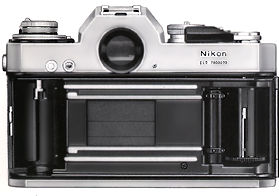
Film Transport Functions The EL2's film transport system is a precision mechanism that maintains film flatness within very close tolerance levels, ensuring that the outstanding image quality of the Nikkor lens mounted on the camera is fully recorded on the film. As the film is advanced, it travels on and is guided by four precision ground guide rails which serve to position the film emulsion surface exactly over the film gate and precisely in the focal plane of the lens. Aiding the guide rails in ensuring film flatness are the film roller and the film pressure plate, both attached to the interior of the hinged camera back. |
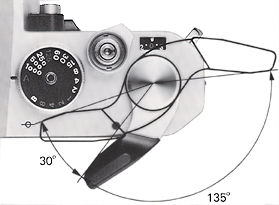 |
Film advance is accomplished by a single, short stroke of the film-advance lever which is plastic-tipped for comfortable and slip-free film advancement backed by ball-bearings around the winding axis. A 135° stroke simultaneously cocks the shutter mechanism, advances the frame counter and frees the shutter release, readying the camera for the next exposure.Moving the lever to the 30° standoff position reveals the red meter 'ON' index, showing that the camera's exposure meter has been activated. Folding the lever flush against the body simultaneously turns off the meter and locks the shutter-release button. |
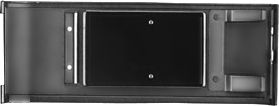 |
Positioned within the camera body, and coupled to the film-advance lever, is the film take-up spool.The film is wound onto the take-up spool emulsion side out, to compensate for the film's natural tendency to curl, thus contributing to improved film flatness. Film feed to the take-up spool is precisely controlled by the sprocket roller located between the spool and the film gate; this roller has sprockets at both ends to engage the upper and lower perforations on the film, and thus provide smooth feed. |
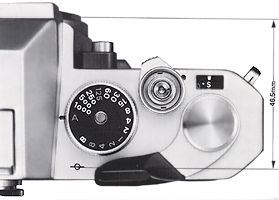 |
In some critical photographic situations, such as close-up or copy photography, the subject-to-film plane distance must often be determined precisely to ensure the best results. Consequently, the EL2 is provided with a film plane indicator (~); the indicator mark is positioned exactly in the film plane, 46.5mm from the front surface of the lens mounting flange.The EL2 came with an additive frame counter directly coupled to the film advance mechanism. With each stroke of the film-advance lever, the counter advances by one to show the exact number of frames exposed. Every second frame from 0 to 36 is numbered in black, with 20 and 36 (the lengths of standard 35mm cassettes) numbered in red. The counter does not operate when rewinding and automatically resets to 'S'(start) (two frames before 0) when the camera back is opened. |
 Film Rewind (Located at the base of the body).
When all the frames in the cassette have been exposed, the film must be rewound before it can be removed from the camera. Depressing the rewind button on the base plate of the camera body disengages the film-advance mechanism to allow the film to be rewound.
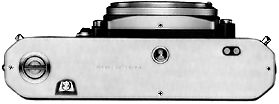 |
The camera back opening knob is fitted with a foldable crank for smooth, rapid film rewinding; the direction of rotation is shown by the arrow engraved on the knob. |
The knob serves as the key for the camera back. The back opens when the knob is pulled up. To prevent accidental opening, a safety catch is built into the base of the knob: turning the catch counterclockwise releases the catch, permitting the knob to be pulled up and the hinged back opened.
Basic
Operation
| Shutter
Mechanism
| Lens
Mount |
Exposure
Control
| Viewfinder
info |
Metering | Flash | Film Advance (Auto) / Transport
|
Back | to Index Page of Nikkormats EL2
| Back |
to Main Index
Page of Nikkormats EL Series
|
Back | to
Main Index Page of Nikkormat/Nikomat
 |
The Eyes of Nikon:- |
Fisheye-Nikkor Lenses - Circular | Full Frame | Ultrawides Lenses - 13mm15mm18mm20mm | Wideangle Lenses - 24mm28mm35mm |
Standard Lenses - 45mm 50mm 58mm | Telephoto Lenses - 85mm105mm135mm180mm & 200mm |
Super-Telephoto Lenses - 300mm 400mm 500mm 600mm 800mm 1200mm |
Special Application lenses:
Micro-Nikkor Lenses - 50mm~55mm -60mm 85mm -105mm 200mm Micro-Zoom 70-180mm
Perspective Control (PC) - 28mm 35mm PC-Micro 85mm
Dedicated Lenses for Nikon F3AF: AF 80mm f/2.8 | AF 200mm f/3.5 EDIF
Depth of Field Control (DC): 105mm 135mm
Medical Nikkor: 120mm 200mm
Reflex-Nikkor Lenses - 500mm 1000mm 2000mm
Others: Noct Nikkor | OP-Nikkor | UV Nikkor 55mm 105mm | Focusing Units | Bellows-Nikkor 105mm 135mm
Nikon Series E Lenses: 28mm35mm50mm100mm135mm | E-Series Zoom lenses: 36~72mm75~150mm70~210mm
MF Zoom-Nikkor Lenses: 25~50mm | 28~45mm | 28~50mm | 28~85mm | 35~70mm | 36~72mm E | 35~85mm | 35~105mm | 35~135mm |
35~200mm | 43~86mm | 50~135mm | 50~300mm | 70~210mm E | 75~150mm E | 80~200mm | 85~250mm |
100~300mm | 180~600mm | 200~400mm | 200~600mm | 360~1200mm | 1200~1700mm
Tele-Converters: TC-1 | TC-2 | TC-200 | TC-201 | TC-300 | TC-301 | TC-14 | TC-14A | TC-14B | TC-14C | TC-14E | TC-16 | TC-16A | TC-20E

Nikon F
| Nikon F2 |
Nikon
F3
| Nikon F4 |
Nikon
F5
| Nikon F6 |
Nikkormat / Nikomat |
Nikon FM
| Nikon FE/ FA | Nikon EM/FG/FG20 | Nikon Digital SLRs | Nikon - Other models
MIR Supports for Photographic Community: Various Message Boards/Community
Forums
Nikon
F-series|
Nikon
F2-series|
Nikon
F3-series|
Nikon F4-series| Nikon
F5-series|Nikkormat/Nikomat-series
Nikon FM-series|Nikon
FE-series|Nikon
FA|Nikon
Digital
SLR
series|Various
Nikon
Models|Nikkor
Optic
-shared
Others:- Free Trade Zone - Photography| Free Trade Zone - Business Community |Free To Zouk - Photographic Community
Apple's Mac Public Community Message Board | Windows based PC &
Apple/Mac
Public Community Trade Exchange Centre
Recommended links to understand
more technical details related to the Nikkor F-mount and production Serial Number:
http://rick_oleson.tripod.com/index-153.html by: my friend, Rick Oleson
http://www.zi.ku.dk/personal/lhhansen/photo/fmount.htm by: Hansen, Lars Holst
http://www.mir.com.my/rb/photography/hardwares/nikonfmount/lens2.htm
http://www.photosynthesis.co.nz/nikon/serialno.html
About
this photographic
site.
Home - Photography
In Malaysia

Copyright
© 1998.
HIURA Shinsaku ® ; Nikomat ML, Japan,
in collaboration with leofoo ®. MIR Web Development Team.
* Credit: A
Great thanks to Mr Denis Pleic for his volunteering
effort to reedit content and and patching some grammatical mistakes found in this
section of the PIM site. Miss
Rissa (Marketing) & Edward
(Techical) of Shriro Malaysia, distributor of Nikon cameras in Malaysia, in providing
so many useful inputs to make this site possible. Mr Hong,
Ipoh for lending me his FT2 to take some of the images used in this site. This site
is created for his eldest son, Yuen who has picked up his father's hobby and
the FT-2. My friend, John Walls from Florida, US for his images of the FTn
body and the Zoom Nikkor
43-86mm.
[Left Brain][Right brain][Home-MIR] [Invention][Art & Design][Clubs]
[Portfolios][On assignments] [Trading room][Knowledge & Resources] [Free-trade-zone][Thoughts & opinions][Links]