Flash synchronization
The Olympus OM-1 and OM-2 works identically when synchronized for flash, but the
OM-2 has the additional facility of automatic-exposure flash via a special accessory
shoe and flash unit and its normal automatic-exposure metering system. In fact, the
hotshoe plays a lot of role to optimize each model's with individual flash units
that has brought to the market with differing features. Thus, to ensure your OM bodies
enjoy the full benefit of the TTL OTF feature, select the appropriate flash shoe
as explained earlier especially when you are using the few TTL dedicated flash units
by Olympus. When using any other third party flash units, it is always recommend
to set the OM-2 shutter to MANUAL via the mode selector.
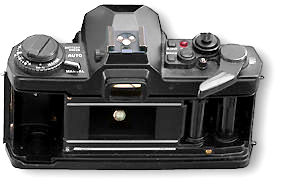 |
In the case of OM-2 (n), OM-2S (Or even OM-3 and OM-4 series etc.) which has TTL OTF flash metering capability, flash emission is monitored through the camera's taking lens by the camera's SBC/SPD light sensors. When the correct exposure has been made, the camera cuts off the flash power output via an electrical connection atop the accessory shoe which communicates with the dedicated flash unit such as the T series flash models. |
Today's popular TTL Direct (OTF) Light Measuring method was actually first seen in a Olympus OM-2 way back in 1975. The ground breaking system pioneered by Olympus was a truly revolutionary method which was so influential that - it was adopted as a standard found in virtually all of today's higher end SLRs for flash exposure control. But back in the mid-seventies, what the OM-2 has brought to us was for the first time, a practical solution to the long disturbing uncertainty of flash exposure calculation for many. This system eliminates complicated exposure calculations associated with highly specialized fields of photography. For example, multiple flash photography and macro photography has never been so easy which previously involves complex calculation especially when use with a tight exposure latitude film type such as slides. In comparison, the OM-1(n) bodies are much more straight forward when operate in flash operation as it is essentially a mechanical camera. Naturally, you will have to settle either in manual or normal auto flash (However, Olympus had another breakthrough with their OM-3Ti which is also a mechanical camera but offers TTL OTF flash exposure control as well as multi spots metering !). Again as a reminder, for the original M-1 or OM-1, use Type 1 shoe; while for the OM-1n, choose Type 4 shoe instead.
 |
But since within the OM system has quite a number of flash units which include specialized unit such as Macro Ring flash and the powerful handle flash other than the older Quick Auto 310, portable T-series flash models such as T20, T32 or even the current T280. |
Theoretically, ALL these units should work with any of the OM-1 bodies in either manual or normal AUTO flash mode. Well, it may takes another few sections before we can complete the Flash Group in the OM-system and if you are in particularly interested in that segment, click here for more info in this site.
"FP" Setting While the convenience of electronic flash was slowly realized toward the mid of seventies but flash bulb still has its following, naturally both of these cameras have provisions to work with both methods. Both OM-1 and OM-2 bodies have a flash synchronization switch around the coaxial socket at the side of the camera. The switch has two positions - "FP" and "X". The "FP" setting is for use with special long-burning focal plane bulbs, which allow the faster shutter speeds to be used. As the film is uncovered only partially at any particular instant during exposures faster than 1/60 see, the faster burning flashbulbs and the even faster electronic flash cannot be used.
Flash Bulb Photography |
||||||||||||||||||||||||||||||||||||||||||||||||||||||||||||||||||||||||||||||||||||||||
"X" setting The "X" setting of the switch is primarily for third party electronic flash other than those designed by Olympus. Flashbulbs and Focal plane bulbs may also be used on the X- setting but since the slow burning characteristics may restrict their usage effectively at speed faster than 1/15 sec, but in the case of electronic flash, the setting can be set at higher sync speed of 1/60 sec (But not beyond that, otherwise, partial exposure across the film will result due to improper synchronization). Other than these, any older flash types with cord connection can be plugged into the terminal. Anyway, to avoid confusion, just set the switch around the flash socket to X for electronic flash or any flashbulb except the FP type. Set to FP for focal plane bulbs only.
Automatic
flash
exposure with
OM-1 and OM-2 bodies
The Olympus Quick Auto 310 electronic flash unit can safely claimed as world's first
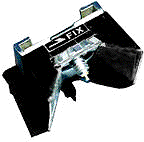
TTL OTF flash unit. It can be attached to the Olympus OM-1 via accessory shoe Type
1 or older "FIX" shoe. With the OM-1, it can perform either as a manual
or auto flash. However, it was primarily as a dedicated flash unit for the OM-2 model
that can regulated flash output by means of a special Accessory Shoe Type 2 - this
innovative flash system was more popularly being referred as TTL OTF(Through the
lens Off the Film) flash metering.
 |
The Quick Auto 310 has a guide number of 34 (meters) for 100 ASA and covers up to 85 degrees horizontal or 55 degrees vertical. It uses the camera sensors for fully automatic operation, thus allowing any aperture to be used, and facilitating close range work, varying the flash duration from 1/1000 to 1/40000 sec. A separate sensor allows the flash to be used off camera. |
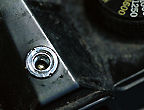
Before the more well known Quick Auto 310 flash, Olympus has a Quick Auto 300 flash which was introduced along with the original Olympus M-1 and OM-1 models. I would not like to mislead anyone to think TTL-Flash capable Quick Auto 310 was not usable with later OM-1n or OM-2n bodies, but when minus the TTL OTF feature, the flash can be used as an normal flash either in auto mode or manual flash control. Anyway, Olympus has replaced the Quick Auto 310 first with the T20 and followed by the intelligently designed T-32 years ago which most users are more familiar about, even earlier first attempt with the Quick Auto flash has some compatibility problems, it is not that significant to doubt what the Olympuses can offer. Sure ? Why not . Just imagine, both the portable flash units from Olympus were so well designed that Olympus has not really need to think of introducing another flash for the SLR Olympuses until recently with a new T280 flash. For a dedicated flash that can last and stay around as new for more than 15 years and yet has not compatibility problem with the latest SLR model - you really have to respect the designer.. not convincing ? Quote me another brand name and a specific model then. You can't, huh ?
The T20 flash is an extremely compact and lightweight portable flash. It is an energy-saving, fully automatic system flash unit capable of TTL Auto, normal Auto and manual flash. For the OM-1n and OM2n bodies, it provides the flash charge/correct exposure indication in the viewfinder. A drawback is being it has NO built in bounce mechanism as with the T32 does. However, it can operates on just two 1.5V AA (self-contained) or four 1.5V C (inside bounce grip) including Ni-Cd, or AC house current. The dimension cannot be more compact and lightweight if these are your priorities: 77 x 68 x 57mm (3" x 2.7" x 2.2"), 160g. (5.6 oz.) less batteries.
The T32 flash is the center of the modular OM Flash photo system. Based on specifications and features alone, the T32 still can easily claimed as one of the best manual flash that was ever designed (especially it is a product of the mid '70), unlike any other flash units offered by any manufacturers during that era, the T32 flash was designed more like a system flash with a host of very useful and practical features built around it. Innovative features such as built-in bounce mechanism allows the flash surface to be tilted 90° up and 15° down. This angle range can be further extended when the T32 is slipped into the Power Bounce Grip 2 (The Power Bounce Grip 1 (Designed for Quick Auto 300 and 310) tilts up 75 degrees and down 15 degrees, while the Power Bounce Grip 2 (Designed for T series flash models) tilts up 90 degrees and down 20 degrees.). A host of other handy accessories such as various zoom heads can extend the flash working range and coverage in accordance to zoom lens setting, colored filters for creative photography etc. but most of all, it enables TTL OTF flash photography to multi-flash setup (Via Power Bounce Grip 2 and TTL extension cords) to ensure more simpler and accurate operations for TTL multi-flash setup.
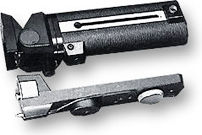 |
Despite its great versatility it offers, it needs to operate only on four 1.5V AA (self-contained) or C batteries (inside bounce grip) including Ni-Cd, or AC house current. 104 x 81 x 70mm (4.1 " x 3.2" x 2.8"), 320g. ( 11.3 oz.) less batteries. The Power Grip design is innovative and practical, why ? Because it can convert a clip on flash such as T20 or T30 into a hammer head handle flash with other extended possibilities. Well, you can have extra power from the additional cells hosed inside the grip and have a separate shutter release button as if it is like a Motor Drive unit on the grip. |
Drawbacks ? Yeap, if I want to be a little fussy over a product that was introduced some 25 years ago (But certainly it would make many other manufacturers bluish...). It will be be very nice to have a tiny fill flash for the T32. I think Metz has a similar design like the Olympus (non-TTL) and I have always been wondering why there is so much similarity in its physical outlook and dimension. Anyway, as far as I am concerned, Olympus effort on the T32 is amazing, if you see and compare a top rank manual flash from the likes of Nikon's most popular TTL flash SB-16B and Canon's first TTL flash model 300TL and possibly you will agree with me.
|
Camera |
Selection of Accessory Shoe |
Selection of TTL AUTO Connector |
Selection of Flash Mode |
TTL OTF Flash Exposure Control with Viewfinder ready light and exposure confirmation LED indication: OM-2n, OM-2 Spot Pgrm, OM-3Ti, OM-4(Ti) |
|
OM-2N |
Shoe 4 |
Type 4 |
• TTL Auto • Normal Auto • Manual |
|
|
OM-1N |
Shoe 4 |
Type 4 |
• Normal Auto • Manual |
|
|
OM10 |
Built onto the camera |
- |
• Normal Auto • Manual |
|
|
OM-2 |
Shoe 3 |
Type 3 |
• TTL Auto • Normal Auto • Manual (1/60 sec. cannot be used) |
|
|
Shoe 2 |
Type 3 |
• Normal Auto • Manual |
||
|
OM-1 |
Shoe 1 |
- |
• Normal Auto • Manual |
|
|
Other cameras |
Hot Shoe |
- |
• Normal Auto • Manual |
| previous | NEXT | 3/4
| Back |
to Main Index Page of OM1(n) & OM2(n) SLR cameras
| Back |
to Main Index Page of Olympus ZUIKO
lenses section
Olympus
OM-1(n): Main Index Page (5 Parts) | Camera Operations (6 Parts)
Specifications: HTML | PDF | Main Reference Map:
HTML | PDF (217k)
Olympus OM-2(n):
Main
Index Page
(6 Parts) | Camera Operations (9 Parts)
Specifications: HTML | PDF (48k) Main Reference Map: HTML | PDF (203k)
Olympus
OM-2SP: Camera Operations | Other Issues
Specifications | Main Reference Map / nomenclature
Shared Resources: Supplementary Articles:
TTL
Metering,
Depth
of Field,
Shutter
Speed
& Aperture
Motor
Drive and Power Winder: Main Index Page (4 Parts)
Motor Drive 1 | Motor Drive
2
| Winder 1 | Winder 2
Flash Photography: Main Index Page (4 Parts)
T45 | T32 | T20 | F280 | S20 | Qucik AUTO 310 | QA300, 200,
200S
Macro-Photography: Main Index Page (3 Parts)
Manual for Photomicro Group (3 Parts) NEW upload !
Macro Flash Units: T10 Ring Flash, T28 Twin, T28 Single,
T8 Ring Flash
Accessories: Databack 1-4 | Screens | Finder Accessory | Remote | Cases
Zuiko Lenses: UPLOADED !!
| Message Board | for
your favourite Olympus
OM-1(n)
and OM-2(n)
series models
| Message Board | for your Zuiko Optics in a shared environment
| Message Board | Specifically for Dispose or Looking for OM Photographic
Equipment
About this photographic site.
 |
Home - Photography in Malaysia |
 |
Copyright
© 2000.
leofoo ®. MIR Web Development Team.
My
old time buddy, Ahmad
Ikram,
Dr of Rubber Research Institute (RRI), Malaysia
who shares the same passion with me and also lending his OM-1n, OM-4 and the Motor
Drive 1 to me for preparing some images in this site. Mr Poon of Foto Poon,
Ipoh, Mr Richard, Ampang Park, Mr Lim and Miss Jenny
of Foto Edar for their generosity for their OM1(n), OM2n camera and some Zuiko lenses.
Mr KKLow for some of his earlier images on the OM-1. Miss Wati and Mirza for helping me to convert
this Operation Manual into a HTML format. Mr MCLau for rectifying some mistakes
made on the earlier preview sites. Site created 'unfortunately' again with a PowerMac
A
personal tribute to the creator of the OM system and also a site dedicated to all
the fans of Olympuses and Zuiko Optics worldwide. Olympus
is a registered tradename of Olympus Inc, Japan.