Probably by now you should be able to realize what the extended benefit of TTL flash exposure control has brought to photography. But for those who specializes in macro photography, Olympus has always enjoying a commanding and respectable position among top camera manufacturers.
 |
The world of macro sometimes deserves more than just macro lens and bellow units, where the OM system is truly the most comprehensive and extensive in its features and equipment among all - currently, there is not less than seven special lenses for macro works with such a comprehensive system comprised of specialized lighting units, filters, reflectors, adapters, focusing stages and more.. which can go to 10 X true magnification ratio. |
Credit: A bacteria from the soil in a rubber estate under 1500% magnification. Courtesy of Dr.Ahmad Ikram of Rubber Research Institute (RRI), Malaysia. Olympus OM-4 Photomicro outfit.
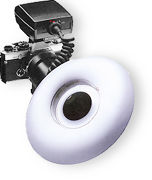 |
The TTL direct light metering and TTL OTF flash exposure control opens up enormous photographic possibilities which includes multi-TTL flash setup, macro-ring flash for shadowless close-up works. |
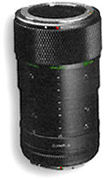 |
Some of the macro photo accessories designed by Olympus are truly innovative and very practical for field use. The Auto-macro extension tube was one which I think only can be found in the medium format Hasselblad System.
In fact, today's Olympus has evolved into a highly successful brand name as a supplier of medical, Photomicro and scientific research equipment of all these has very attributed from the original photographic OM system.
System Accessories
- OM
Motor Drives
and Power Winders
The compact size of the Olympus bodies of OM-1 and OM-2 could amaze anyone that are
familiar with the bulkier size of Nikon, Canon or Minoltas. As I said, these jewel-like
bodies are neither fragile or produced to service the 'ordinary' users. The main
mirror mechanism, is more than tough enough to take the demand of high speed motorized
photography of up to 5 frames per second (5 fps). This took the OM-1(n) and OM-2(n)
among the top ranking professional camera bodies available during its time.
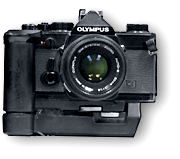 |
The more amazing fact was being, even you are not a fan of Olympus, but it would still made someone kept scratching his head wondering how could Olympus made their Motor Drive so small and yet enabling such high standard in its performance ? |
A distinctive look of the Olympus Motor Drive(s) or Power Winder (s) can be easily distinguishable from a far as as its unique motor drive design are shorter in length at its base when mounted onto a applicable Olympus SLR camera body. The original Motor Drive 1, measuring only at 116 x 82 x 66mm (4.57 x 3.23 x 2.59 in.) and weighing around 210g (7.4oz.). It is truly amazing to see such excellence in engineering to be realized by the engineering wizards at Olympus. The second Motor Drive, named as Motor Drive 2 is larger and heavier at 143 X 77 X 93mm (5.6" X 3.0" X 3.7") and weighing 360 g. (12.7 oz.). But it was a great improvement over the earlier version, which includes a LCD panel display, which even has a step-by-step indications for film loading, and automatically winds* it two frames to bring the counter to the start position. When the counter reaches "0", the film advance is automatically disengaged, and the LCD gives indications for rewinding the film. For specific model such as OM-4, it even provides motor driven film rewind.
" ... OLYMPUS 250 FILM BACK1 WITH 35-POF This is an Olympus 250 exposure back with the 35-POF computer attachment made by Miletus Assoc., New Mexico. I think this was made for record keeping and used by the USN. It will work as a long roll back on any OM1 or 2 and maybe with the OM3 & 4 as well. At any rate it's a cool item and if your into OM cameras this might be a great addition to your collection. It would work well for large group photos or sporting advents...." - Michael -
 |
 |
Credit: Images courtesy of Mr. Michael Chandler® <Dexcam1@aol.com> where he also operates a popular Ebay Store as well as a website on their own at www.dexterscamera.com Dexter Camera also can be reached by writing to: Dexters Camera 484 E Main St Ventura Ca 93001 USA 805-643-2172. Images copyright © 2003. All rights reserved. |
|
 |
* Note: Motor Drive 2 supports automatic advance to frame 1 with the OM-2 Spot Program, OM-3, OM-3Ti, OM-4, OM-4Ti. It also enables Automatic Film Rewind only for OM-3, OM-3Ti, OM-4, OM-4Ti bodies.
But unlike any other manufacturers, Olympus has actually designed two motor drives and two power winders so far - and yet each of their SLR models may find a companion automatic film advance device to be shared, and interchangeable* with one another. * Note: Some entry models such as OM-10 can only be used with a power winder and not workable with any of the Motor Drive. The original M-1 and early OM-1 bodies do not have a motor drive coupling cover at the base plate and they will not permit the use of Motor Drives unit but some photographers use the small "MD" plate in front of the camera body to differentiate them.
What and which model of Motor Drive or Winder fits your requirements mainly depends on which camera model you owned, features you would wish to have and what type of photography you are engaging more with before you decide. Say, if you have a OM-1n and possibly like to focus mainly on nature, a slower but more economical Power winder should be a logical choice. If you are a proud owner of a OM-4Ti and engaging more in action related or fashion photography, to fully optimized all features presented in your camera, auto film rewind, LCD display and high speed Motor Drive 2 would seem like a better option. There are a couple of features that have being improved, refined and incorporated into the Winder 2 and Motor Drive 2 from earlier versions. What are the improvements then ? (actually Winder and Motor Drive are identical but generally we use to differentiate them in terms of performance and features - Winder usually performs film advance at 2 fps while a motor drive hits higher advance rate than that; further, there are some additional features such as auto film rewind may also be found in a motor drive , while it is generally not provided in a cheaper power winder). In the case of Power Winder, Olympus original Winder 1 can operate only in single frame, while the Winder 2 permits sequence operation at 2.5 frames per second (fps). While most don't see any backward compatibility problems of older Winder with newer SLR bodies, but some claim the differential voltage of older Winder could post some problems with newer Olympus SLR bodies. Anyway, as I said earlier, it is justify to invest into a Motor Drive to take advantage of the extra features it embodies in a new SLR/MD combination and it may help to address some of these potential problems.
There seem to be more Motor Drive 1 than Motor Drive 2 in the used market. Naturally, there are cheaper in comparison. But is it justify to invest into one of the older drive and what are the differences between newer and older ones in terms of performance and features? First, there are also two versions of the Motor Drive 1 with older version comes without a remote cord input and there is no slot provided to store the motor drive coupling cover from the body which you might misplace it. The subsequent Motor Drive 1 has such a considerate feature provided a top the Motor Drive 1. Motor Drive 2 has different location for storing where it can be screw directly The while it screws into the back of the grip for safekeeping. The Canon's Motor Drive MA also has that feature when it was introduced, but since the Olympus MD-1 was introduced earlier than the Canon, I just have to assume it was Olympus who pioneered the idea. How about others ? Oh... The Nikon only has that with the Nikon MD-4 in 1980..
Basically, the Motor Drive 2 is a far improved model from version 1. It even has an LCD display which shows film loading, rewind, and film removal sequences. The frame counter is designed to counts down from the preset number of frames to zero, then it will automatically stops. With specific 'high-end' models*, it even permits auto film rewind as well. * OM-, OM-3 Ti, OM-4 and OM-4Ti Other than OM-1MD, OM-1n, OM-3, OM-3Ti and a very well-spec OM-2000 - which are mechanical bodies, the rest of OM models are essentially automatic SLR cameras. The Motor Drive 2 has another design whereas it will automatically advance to frame 1 when it senses attachment of either a OM-2 Spot Prog ram, OM-3, OM-3Ti, OM-4, OM-4Ti, OM-20, 30, 40 body. This eliminates chances of mirror flipping when you have accidentally set the mode selector to "AUTO" position. Physically, the hand grip of MD-2 has a better human engineering factor than that of the version 1. Further, there are a few extra electrical contacts a top of the drive, there is also a rewind claw for film rewind, and a rewind coupling to support the enhanced additional features it provides with some specific bodies it supports. The LCD display is a joy to use compared with the levers and buttons of the Motor Drive 1. It has a bigger dimension and heavier in weight but the finishing and built quality is apparent. Unless there is some financial constraints or if you are using the older versions of OM bodies which has little benefits to enjoy with, the version 2 looks more like a better investment. With a motor drive or in some cases when a power winder is used, it will open up another scope of possibility for unmanned photography or generally, we referred it as Remote Photography. Unlike most modern SLR that has their film loading and advancing automated by incorporating a built-in winder and possibility of remote sensor; most manual focus cameras has it as an optional features or added on attraction to attract buyers for accessory such as Motor Drive or Winder. I think Yashica/Contax was the first to change that concept by incorporating a built-in remote sensor for their Contax SLR models. Anyway, most OM bodies can handle sophisticated remote photography via a motor drive unit or in a simpler form, by mean of cheaper remote cords.
Personally, I am very impressed with Olympus photographic system as a whole and I was almost invested into Olympus photographic system if not put off by the idea with my local disrtributors' high price tag fixed on the Motor Drive (It was ridiculously priced almost double that of Nikon's MD-12 and sold even 40% higher than that of a Nikon F3's MD-4 !). Strange to see just an photographic accessory can affect one's decision to invest into buying a camera.
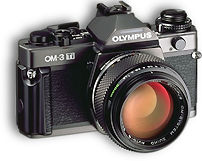 |
But those early days of research did benefited me a lot while over the years, the trading experience in used equipment has also helped me in accumulating a broad base of knowledge for the Olympus photographic system. But personally, it remains as an unfulfilled wish of owning a Olympus camera even for collection purposes (Who can resist the temptation owning a modern classic SLR such as the OM-3Ti which personally I would easily rank it as one of the two BEST mechanical SLR camera available on the market today, huh ?). |
Frankly, Olympus
has another jewel in the making. The much rumored Cosina-made mechanical OM-2000
has turned out to be a winner at the entry camera segment. Personally, I would also
rate the OM-2000 as the best entry camera available on the market right now. Frankly,
even neither the mechanical Nikon FM-10 nor the electronic FE-10 (also rumored to have been
produced under license by Cosina) was no where close. Even if what the suspicion
was true, I thought at least the people at Olympus has pride and pay more attention
to their trade name to the like of Nikon by drawing out such good specifications
for the OM-2000. the more comforting part is, finally, we have a very well made,
practical but also very realistically prized entry camera here for beginners and
students which all the while I thought most of the manufacturers are far from convincing
showing any interest or performing their duty to promote photography.
Although both OM-1 and OM-2 share many similarities from the exterior like both have
virtually same dimensions and with almost identical mechanical functions, the electronic
OM-2 does, nevertheless, have some minor visual differences as compared with the
mechanical counterpart. While both of the bodies can be completely removable if necessary
to fit the 250 or Recordata Backs, some earlier versions of the bodies would require
a cable connection and newer bodies have databack terminals incorporated at the back
of the camera. Obviously, the mode selector lever has an additional 'AUTO" to
set. Another one is being - the OM-2 has a battery check light to the left of the
viewfinder eyepiece, brought into operation by the meter switch. Subsequently, OM-1n
also is equipped with viewfinder ready light feature. The eyepiece for both models
are quite similar and takes the same accessories. It is, however, those found in
later versions of the OM- bodies have been slightly redesigned and more recessed
than on the earlier OM-1 models. Anyway, most of these differences mentioned are
mainly upgrades and refinements from older models.
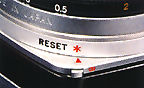 |
However, a view from the right-hand side shows a notable omission of a mirror lock button/lever on the OM-2 series body. While at left-hand side, there is also an unusual 'reset' button on the electronic OM-2 bodies. The button is necessary to reset the shutter mechanism (Generally, the mirror will flip on a upward position) if batteries fail or the shutter is released with no batteries in the camera. |
The last of the OM series, OM-2 Spot Program is very similar to the OM-4 (It was introduced after OM-4 in 1984), the usual Mirror Lock up button found on the OM-1 bodies is replaced with a viewfinder illumination button. And the usual 'reset' button found on the OM-2 bodies is replaced with a 'B' Lock button. (Red shutter settings on the manual shutter speed ring can only be reached after depressing the 'B' Lock button, the mechanically set 1/60 sec selected when battery is completely depleted or 'B' is set manually for long time exposures.
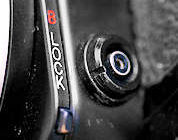 |
For any non-OM SLR users, this 'mysterious' button could create some confusion and wondering what is the function or usage it provides. |
The OM-4 (Obviously, it takes a electronic camera that depends on battery to power the camera to have that kind of problem (Mirror stuck upward)...the mechanical bodies such as OM-1(n), OM-3(Ti) or OM-2000 will not be seeing this on the lens mount). The OM-4(ti) has different design to replace the reset button found on the OM-2 bodies (Other than OM-2 SP). < --- Bulb ('B') and 1/60 sec lock setting and just beside the PC sync socket at the lower right hand side of the lens mount.
| previous |4/4 |
Back |
to Main Index Page of OM1(n) & OM2(n)
Olympus
OM-1(n): Main Index Page (5 Parts) | Camera
Operations
(6
Parts)
Specifications: HTML | PDF | Main Reference Map: HTML | PDF (217k)
Olympus
OM-2(n): Main Index Page (6 Parts) | Camera
Operations
(9
Parts)
Specifications: HTML | PDF (48k) Main Reference
Map: HTML | PDF (203k)
Olympus
OM-2SP: Camera Operations | Other Issues
Specifications: HTML | PDF | Main Reference Map: HTML | PDF
Shared
Resources:
Supplementary
Articles:
TTL
Metering,
Depth
of Field,
Shutter
Speed
& Aperture
Motor
Drive and Power Winder: Main Index Page (4 Parts)
Motor Drive 1 | Motor
Drive 2
| Winder 1 | Winder
2
Flash Photography: Main Index Page (4 Parts)
T45 | T32 | T20 | F280 | S20 | Qucik AUTO 310 | QA300,
200, 200S
Macro-Photography: Main Index Page (3 Parts)
Manual for Photomicro Group (3 Parts) NEW upload !
Macro Flash Units: T10 Ring Flash, T28 Twin, T28 Single,
T8 Ring Flash
Accessories: Databack 1-4 | Screens | Finder Accessory | Remote | Cases
Zuiko Lenses: UPLOADED !!
| Message Board | for
your favourite Olympus
OM-1(n)
and OM-2(n)
series models
| Message Board | for your Zuiko Optics in a shared environment
| Message Board | Specifically for Dispose or Looking for OM Photographic
Equipment
About this photographic site.
 |
Home - Photography in Malaysia |
 |
Copyright
© 2000.
leofoo ®. MIR Web Development Team.
My
old time buddy, Ahmad
Ikram,
Dr of Rubber Research Institute (RRI), Malaysia
who shares the same passion with me and also lending his OM-1n, OM-4 and the Motor
Drive 1 to me for preparing some images in this site. Mr Poon of Foto Poon,
Ipoh, Mr Richard, Ampang Park, Mr Lim and Miss Jenny
of Foto Edar for their generosity for their OM1(n), OM2n camera and some Zuiko lenses.
Mr KKLow for some of his earlier images on the OM-1. Miss Wati and Mirza for helping me to convert
this Operation Manual into a HTML format. Mr MCLau for rectifying some mistakes
made on the earlier preview sites. Site created 'unfortunately' again with a PowerMac
A
personal tribute to the creator of the OM system and also a site dedicated to all
the fans of Olympuses and Zuiko Optics worldwide. Olympus
is a registered tradename of Olympus Inc, Japan.