 |
Year of introduction and discontinuation of OM-1 and OM-2 SLR models: |
OM10 (1979-1987),
OM-10 Quartz (1984-1987), OM20/OM-G (1983-1987), OM30/OM-F Focus Assist (1983-1987),
OM40/OMPC (1985-1987), OM77AF (1986-1991), OM88 (1988-1991), OM2000 (1998-.... )
Olympus OM-1 and OM-2
The Olympus OM-1 was introduced in 1972 as the first of a new breed of small lightweight
single lens reflex cameras. There were three known versions of the regular production
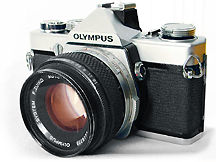
of OM-1. The original model, was called "M-1" and it was later changed
to OM-1 a year later in 1973. The M-1, estimated roughly to have around only a few
thousand units being sold worldwide while despite the fact that is was not a 'complete'
full blown version of the eventual OM-1 as we all known, it was made a favorite among
collectors because of its scarcity and a little 'fancy' background (Where most believe
Olympus changed their M-1 due to Leica's claims infringement on their Leica M-1 trade
name). However, earlier M-1 and OM-1 bodies had not designed to have it work with
a motor drive unit. The first known improvement was made in 1974 where the OM-1 body
was supplied with a base plate that enable it to use with the motor drive 1 (It is
easily distinguishable with a small 'MD' label which indicates it is motor drive
enabled. Nevertheless, all earlier OM-1 bodies could be modified by Olympus agents
to take the motor drive but subsequent export models had the motor drive connections
factory fitted. Besides, newer bodies have a direct databack contacts near the film
rail, while older versions would required a cable connection (Data back 1) to connect
it to the synchro socket at the front of the camera. The OM-1 MD had another minor refinement made on the
flash contact and when a dedicated flash unit is used, full flash charge is indicated
inside the viewfinder. Generally, Olympus users referred the upgrade as OM-1n and
basically these were used to differentiate original M-1, OM-1, OM-1MD
and OM-1n in which the later upgrades have some other less noticeable improvements.
The refinement made on the original OM-1 model and the system that grew around the camera body has caught many industrial observer's attention from this relatively new player in the SLR market during early days of its debut. But Olympus has made more eyebrows rose later - continuing the tradition of the OM-1, the Company introduced the OM-2 as the smallest camera of its type in 1975/6. Unlike the mechanical OM-1 counterpart, the OM-2 is an automatic-exposure 35 mm single lens reflex came with a new concept in a revolutionary TTL off-the-film metering system as well as the world's first practical solution to flash exposure control. The system used will measure light through the lens and off the film plane (TTL-OTF). Despite the sophistication of the camera design, Olympus engineers still able to retain dimensions of this auto camera exactly the same as those of the OM-1 - 136 x 83 x 50 mm without lens. This means the new body also can share virtually all system accessories within the equally impressive OM photographic system that has taken shape very well over the few initial years after the debut of the original M-1.
As with the OM-1, the OM-2 has gone through a few upgrades to refine its performance and improved the ease of handling. Some differentiate the upgraded model from earlier OM-2 as OM-2n, basically it relates more to the flash connection where a full flash charge ready light inside the viewfinder is provided (LED lights up when flash full charge is ready, blinks when flash exposure is completed or maximum flash output) and improve the mirror reset procedures and auto power off after around 3 minutes. (Previous OM-2 will drain the battery if left unattended if Mirror is locked and awaiting reset by switching to "B" where it is a mechanical setting). Further, OM-2n has an additional color tab inside the viewfinder display to remind photographer if exposure compensation is being activated while OM-2 has to depend on the photographer's awareness or attention if such operation is being used and no visual indication is provided to reset to neutral value. The OM-2n has another unpublicized upgrade in which the metering shutter curtain pattern where the distribution of the metering pattern was made more evenly distributed for center-weighted metering reading.
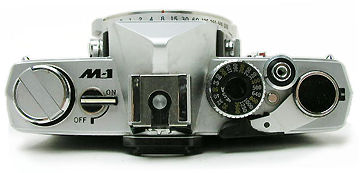 Credit: Images of the original Olympus M1 courtesy of Adorama® Inc. "Ebay - Mathew Duren" <ebay@adorama> Webisite URL: Adorama.com, who also operates a popular Ebay Store. All images appeared herein are Copyright © 2003. All rights reserved. Please respect the visual property of the contributing photographer. |
 |
|
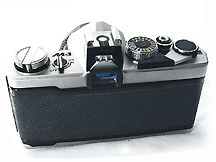
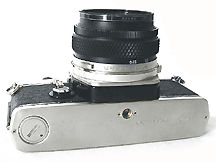
CLICK on thumbnail(s) to see an ENLARGED view Images ontributed by Larry Shapiro |
|||
 |
 |
 |
 |
OM-1 Highlights (OM1(n) Website)
The main feature of the Olympus OM-1 was its then exceptional compactness and light weight. The body measures merely 136 x 83 x 50 mm and weighs 490 g (17.3 oz). With the heaviest standard lens - the Zuiko 50mm f 1.2 - it weighs only 800 g (28.2 oz).
 |
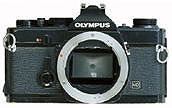 |
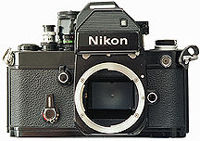
If a visual comparison (To scale) at left is not convincing, refer to the fact sheet below: The dimension of Nikon F2S's is 152.5mm x 65mm x 110mm and weighs 880g without a lens attach ! |
It is a 35 mm single-lens reflex taking 35 mm film in standard cassettes and giving pictures 36 x 24 mm. It has a fixed pentaprism, but interchangeable viewfinder/focusing screens. Among the unusual features are the film speed setting dial in the position more commonly occupied by the shutter speed dial. Another unusual feature of the OM cameras is being, The shutter speed ring sits on the exclusive OM bayonet lens mount bayonet mount of the body, and is concentric with the aperture dial on the lens. This design is somehow similar to Nikon's midrange compact bodies of Nikkormat series models that introduced back in 1965. The metering system is of the full-aperture type, reading through the lens via two cadmium sulphide (Cds) light sensors.
 |
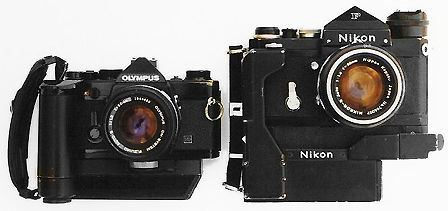 |
<<< -- Credit: Image of OM1/MD and Nikon F/F36 apeared at far right courtesy of Mr Rick Oleson® <rick_oleson@yahoo.com> who also co-maintains the popular OM Message Board in PIM site. Image Copyright © 2003. All rights reserved.
* 7 fps with high-power NiMH Pack; 6 fps with NiCd AA batteries.
In most other aspects
the camera is a conventional SLR of its type. Although the OM-1 is compact and even
can considered extremely light weight compared with most SLR on the market, while
this could easily fool some one to believe it is an amateuristic camera model, but
despite its weight and dimension - the OM-1 is a full blown professional grade SLR
system camera. Along with the OM-2n, these two cameras form the nucleus of the OM
photographic system. At one stage, the Olympus actually was top among the few more
well known players in Japan. Each of the camera models introduced has its own distinctive
features and pioneering technology incorporated to be claimed as a true modern classic.
But how could the OM bodies be made such compact ? Basically, it was very much attributed
to the mastery stroke in the genius of chief designer, Mr. Maitani.
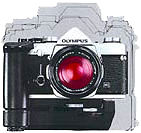 |
Generally, the OM-1 was made some average of 30-35% smaller than any system SLR available during the beginning of the '70 (By mid-seventies, Pentax eventually introduced a series of equally compact ME-'X' series models rivaling such clear dominance of size first achieved by OM bodies). Even with a motor drive attached, the size and weight reduction is significant illustrated at left when compared with other major camera brands. |
Further, neither the OM bodies are inferior in terms of ruggedness and dependability, as the OM bodies were designed for hard and demanding professional use and even able to withstand the stresses and punishment of high speed five-frame-per-second motor drive operation. This ranked equally in performance with any other high flying professional grade SLR such as the Nikon F2. In fact, other than special production high speed motor drive, neither the Nikon F2/MD-1 (4 fps) nor the Canon first professional body of Canon F-1's Original Motor Drive Unit (3 fps) or MF Motor Drive (3.5 fps) achieved such high speed rate of automatic film advance. The Nikon MD-2 eventually brought similar high speed rate of 5 fps to the Nikon F2 while Canon made it via their impressive Motor Drive MA for their Canon A-1 introduced almost 5 years later in 1977.
Comes to think of it, you really have to respect Mr. Maitani's accomplishment. Because, OM cameras are not designed just as simple as a SLR camera. It represents a concept, a dream, an ideology of how a photographer envisions an imaging tool should be like to help one to be more responsive, easier to handle and enabling a more productive and creative photographic experience with all those fine handling and well thought out characteristics and the best of human engineering factors.
The compactness was achieved through more rational design with a new approach to structural component and elements. New materials and engineering techniques were developed, experiment, tested and tried out for practical implementation. Even layout of other mechanical sections was redesigned to achieve gain in compactness or weight without sacrificing ruggedness and durability. To improve smoothness and quietness during operation which is so associated with most SLRs of mechanical type, the cause of them are analyzed and reduced or eliminated one by one while on the other hand, new system was implemented such as the use of a special high precision air-damper for the mirror to offset mirror bounce, there were even four ball-bearings trains were used to achieve smoothness not experienced in any earlier SLR bodies, to adoption of lightweight curtain drums for the shutter and many strategically placed shock absorbers to enable the OM bodies achieve and defining a new level of smoothness, quietness and operational ease.
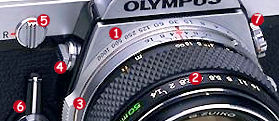 |
Front portion of any OM cameras has all the major control features packed around the bayonet mount and let the photographer has easier reach for control. 1) Shutter Speed Scales, 2) Aperture Ring at external end of Zuiko lens, 3) the manual shutter speed ring holder, 4) Mirror Lock Up lever, 5) Film rewind, 6) Self timer lever, 7) PC sync terminal. |
There are a few unconventional features found in the OM bodies if one is familiar with a conventional SLR camera design. First, the 'usual' shutter speed dial where you'd expect most SLRs locate the shutter-speed dial, it is replaced with the film speed dial (In the case of the automatic OM-2, the film speed dial is designed as dual purpose dial and embedded within an exposure compensation dial, marked in 1/3 stop increments, from +2 to -2 stops). The shutter speed ring has been designed just as an extension of the OM bayonet mount. To avoid confusion between the two rings of aperture and shutter speed control, the aperture ring of any prime Zuiko lens (Except zoom lenses) is designed the the external end of the lens, separated by the focusing ring.
There is also a unusual rewind half- turn button for film rewind situated right in front of the camera body. The design is very similar to Leica's rangefinder bodies and it is, in many ways more logical than conventional design found at the base section of many SLRs. Functional because, camera handling be made more responsive such as you can even handle film rewind while the camera mounted on a tripod. Actually, un conventional because you are not used to it, but once you get used to the controls, however, operation is easy, even more responsive and comfortable. Another worthy feature to look into the OM-1 is its inclusion of a Mirror Lock-up feature. Olympus eventually dropped off the design from their next OM model onwards and thus making the OM-1 the sole model within the OM system that has that useful feature.
| previous | NEXT | 1/2
| Back |
to Main Index Page of OM1(n) & OM2(n)
| Message Board | for
your favourite
Olympus
OM-1(n)
and OM-2(n)
series
SLR Camera models
| Message Board | for your Zuiko Optics
in a shared environment
| Message Board |Specifically for Dispose or Looking for OM Photographic
Equipment
Olympus
OM-1(n): Main Index Page (5 Parts) | Camera
Operations
(6
Parts)
Specifications: HTML | PDF | Main Reference Map: HTML | PDF (217k)
Olympus
OM-2(n): Main Index Page (6 Parts) | Camera
Operations
(9
Parts)
Specifications: HTML | PDF (48k) Main Reference
Map: HTML | PDF (203k)
Olympus
OM-2SP: Camera Operations | Other Issues
Specifications: HTML | PDF | Main Reference Map: HTML | PDF
Shared
Resources:
Supplementary
Articles:
TTL
Metering,
Depth
of Field,
Shutter
Speed
& Aperture
Motor
Drive and Power Winder: Main Index Page (4 Parts)
Motor Drive 1 | Motor
Drive 2
| Winder 1 | Winder
2
Flash Photography: Main Index Page (4 Parts)
T45 | T32 | T20 | F280 | S20 | Qucik AUTO 310 | QA300,
200, 200S
Macro-Photography: Main Index Page (3 Parts)
Manual for Photomicro Group (3 Parts) NEW upload !
Macro Flash Units: T10 Ring Flash, T28 Twin, T28 Single,
T8 Ring Flash
Accessories: Databack 1-4 | Screens | Finder Accessory | Remote | Cases
About this photographic site.