|
Modern Classic SLRs Series
Nikon
F -
Variations
& Special
Models
|
| |
Well, I have to admit I don't
know all of the available Nikon F variation, as there are literally many other models,
one-offs, and custom modifications to the F floating around out there. These are
a few of the more famous ones. A much nicer source of information is at Stephen
Gandy's Cameraquest.
(* Also refer to some special and prototypes models of Nikon at MIR).
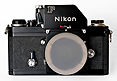
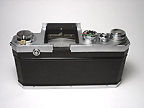
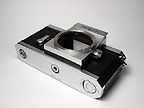
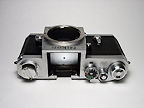
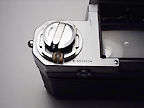
Nikon
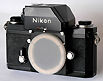
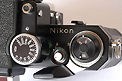
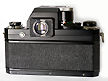
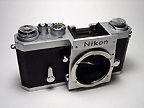
F Red Dot This is probably the most misrepresented special model, thanks to some
inadvertent misinformation in Peterson's Nikon System Handbook.
Red Dot models may be identified by a red dot next to the serial number; the appropriate
serial numbers are 659xxxx and 660xxxx. When the Photomic T finder was introduced
in 1965, the top plate of the camera body was slightly revised; the eyepiece of the
T finder was slightly larger than on previous finders, to accomodate the relay prism
and lenses which allowed for through-the-lens (reflected, continuous) light metering.
Previous meters had a direct path to the source of light via either a light-gathering
window ("Model x" meters) or a lens (Photomic prism). Thus, the red dot
indicated those bodies shipped from the factory which originally had the eyelevel
prism mounted, but which would take the Photomic T finder without modification. Previous
serial number-model F's will require (or have had) modification to accept the T and
later Photomic finders (Tn, FTn); this modification consists of grinding out the
top plate slightly to accomodate the extra eyepiece size.
 |
 |
 |
<<< ---Credit:
All images courtesy of Mr. Peter Kunst <tinakunstt@hotmail.com> . Peter and Tina operate a pupular Ebay Store, selling many interesting used Photo equipment
of various brands. Image copyright © 2003. All rights reserved. Please respect
the visual property of the contributing photographer.
|
 |
 |
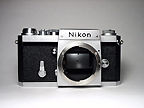 |
Red Dots are neither rare
nor specialised enough to warrant their rarefied prices. They are slightly more exceptional
than your run-of-the-mill F, but all later bodies (67xxxxx +) incorporate their "refinement"
and a lot of earlier bodies have been modified to the Red Dot spec. Personally, if
I had $1 000 US to invest in a collectible F (I'd look for an interesting lens, first
off, but that's a topic for later discussion ...), I'd rather get one of the early
(6400xxx) models to trace the evolution of the F; heck, for $1000 US, I could almost
afford an SP. One word of warning: for those of you shopping on eBay, virtually anything
that is collectible will have an inflated price, whether calculators or cameras.
It's nice to have whatever you want right at your fingertips, but remember that you're
dealing with "experts", real and self-styled, who have plenty of money
to throw at these auctions. Watch out for "shill" bidders; though eBay
tries to control them, I have heard they're still operating.
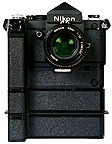
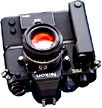
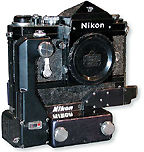
Nikon F - High
Speed Motor Drive Camera
. There
are two extremely rare F high speeds, 1971 and 1976 models. It is a testament to
Nikon's fundamentally sound professional-body design that they are able to regularly
offer slightly modified bodies and motors which far outperform their peers (and even
some modern counterparts).
 |
The 1971 F High Speed delivers
7 fps with the mirror locked up (regular F/F36 combinations offer 4fps with MLU).
I am still sketchy on the details of this model, but it apparently ran off a (cordless?)
pack containing sixteen "AA" cells (although 24V may seem like a lot of
potential, the later F2 High Speed-MD would use four MN-1 packs, for 30V
of potential).
The 1976's version
II Nikon F High Speed
delivered 9 fps for photographers at the Montreal Winter Games. Although similar
to the previous 1971 model, the 1976 model reputedly came in a 250-exposure subvariant,
although very few of them were produced.
| Photo
Showcase
| on Nikon F high Speed Motor Drive
camera (x3) models
Page
1 Nikon F High Speed
Model 1 | Page
2 Nikon F High Speed
Version 1 | Page
3 Nikon F High Speed
Sapporo Winter Olympic Model
Credit: Image courtesy of Mr. Peter Coeln from LEICA Shop®, Austria who also operates a popular Westlicht Auction House. Image Copyright © 2008. All rights
reserved. Please respect the visual property of the contributing photographer.
|
- Whenever collectible F's
are mentioned, and especially F High Speeds, I continue to hear the name of the late
Jose Wu Chang; perhaps one of you out there would be so kind to shed some light on
his collection. These cameras had a pellicle mirror.
Nikon F APOLLO |
Click here
for Nikon F Apollo
Model |
Courtesy of Mr Marc Vorgers <marc@v3d.nl> Apollo
is the nickname given to the F's in the last year(s) of production, 1972-74, and
refers to the use of plastic-tipped winding and self-timer levers. Although it's
useful to know that such F's incorporate all of the lessons Nikon learned from its
devoted corps of photojournalists and users, and are fairly refined, it again seems
to be a source of overinflated prices. The plastic tips are a bit nicer on your fingers
and thumb, but for similar or lower prices, both the F2 and F3 offer the same refinement
as well as shorter winding strokes and smoother overall operation. Then again, if
you're assembling a collection of F's ...
Nikon F NASA You can pick up one of the rarest
Nikon F's in existence for free; the only catch is that it's on the moon ... Hasselblad
advertised something similar a few years ago, but the Nikon F's that the Apollo astronauts
brought there were just as rare and rugged as those 'blads.
 |
The later professional bodies
were also featured on space missions, and I've seen pictures of the space shuttle
version of the F3: very purposeful and massive; probably easy to operate with gloves
on. NOTE;- There is a showcase on NIKON F3 NASA 250 with NASA-modified Nikkor
35mm f/1.4 in
MIR site.
|
<<<----
Picture Courtesy of HIURA Shinsaku of Nikomat Club, Japan.
Nikon F NATO
I don't know much
about these other than that they were produced in either white or olive and distributed
for NATO use. It is possible that their specifications were similar to those made
for the US military (KS-8xA series). "Did you know there some Nikons F with
a "T" ingraved in the film rewind crank? This means that such a camera
is bought as taxfree on a militairy base." - Ted Wengelaar - [Updated info]
(any conrbution ?)
Nikon F White
Leather These are
the rarest F's that I know of: total production of two. They were built on request
for John Faber Mountain Lakes, New Jersey in 1963, serial numbers 6507770 and 6507771.
The production count was later confirmed by Nippon Kogaku in 1982.
(any conrbution ?)
 |
Nikon
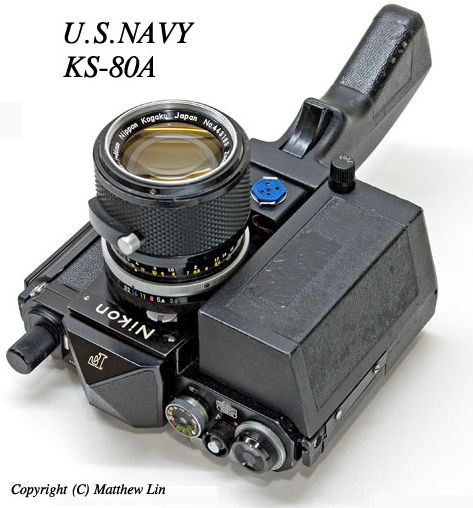
F Navy KS-80A This F came with
an F36, the pistol grip, and a 43-86f/3.5. It was built mainly for the US military
as a "grab shot" kind of camera -- i.e., with one hand driving/flying/whatever,
you could use the other to take pictures with it. Actually, I think that it was used
mainly for aerial photography, with the 43-86 sporting an infinity lock of some kind
(it would make sense, too, that you wouldn't want to take both hands off of the airplane's
controls). Stephen Gandy knows
a lot more about the KS-8xA series (apparently, different models were built by a
single person, to fulfill a contract that EPOI had taken out with the military),
and his much
better page dealing with these
cameras is the best reference that I know of.
A beautifully captured
photo of the Nikon F US Navy KS-80A model by Matthew Lin. Image courtesy of Matthew Lin®. Matthew also maintains an excellent
Nikon/Nikkor personal site where you can access to some oldies. Images copyright
2008. All rights reserved. Please respect the visual property of the contributing
photographer.
|
 |
Nikon F KS-80A Kit 'U.S. NAVY'
Nikon F black Tokyo engraved: U.S. NAVY with prism finder, raised rewind knob,
back with all U.S. NAVY details, modified F-36 motor Tokyo engraved U.S. NAVY, hand
grip with electric release, spare back. Approx. Year: c.1964
Credit: Image courtesy of Mr. Peter Coeln from LEICA Shop®, Austria who also operates a popular Westlicht Auction House. Image Copyright © 2008. All rights
reserved. Please respect the visual property of the contributing photographer.
|
Early/Prototypes on Nikon F Early Nikon F's have a hollow winding
lever, a squarely-shaped and cross-hatched (knurled) self-timer lever (rather than
the usual "stripes" along the lever's length), "Nippon Kogaku"
engraving inside the eyelevel prism, a fairly coarse Fresnel pattern on the screen,
which should be notched on both the left and right sides (sot that you can insert
it in either orientation), and some patent numbers engraved inside the slip-off back.
See also Cover III (inside back cover) of the September 1969 Modern Photography.
Some of the very earliest F's have cloth shutters, instead of titanium foil. Of all the collectible
Nikon F's, I would most want this one (of all the collectible Nikon products, I'd
most like a 300f/2.8 Preset Nikkor-H ED, but that's not happening any time soon).
I feel that, along with the KS-8xA's and High Speeds, these are the most mechanically
distinctive and, as such, deserve the highish prices I'm beginning to see for them.
(any conrbution ?)
-
 |
Nikon F Specially
Numbered
- Similar to Leica's issuing
the MP to famous Leica users, such as Eisenstaedt, Nikon gave the 500 000th F to
the American photographer who perhaps most aided the ascendance of Nikon: David Douglas
Duncan. I believe that there was no mechanical or functional distinction of this
camera, unlike the MP. (any
conrbution ?)
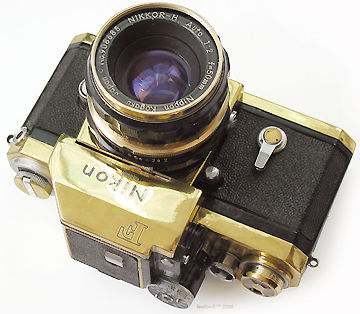
Nikon F Gold Finish body
| Photo Showcase | on
Nikon
F Gold with Non-Ai 50mm f/2.0
standard lens.
|
 |
| Photo Showcase | on
"NIKKOR"
F camera models
A Black NIKKOR
FTn and Chtome Photomic Body with Non-Ai 50mm f/2.0; these were believed to be made
for German export market.
Credit: Image courtesy of Mr. Peter Coeln from LEICA Shop®, Austria who also operates a popular Westlicht Auction House. Image Copyright © 2008. All rights
reserved. Please respect the visual property of the contributing photographer.
|
With a lot of help from my
friends:
Contributing
Site: Nikon F in Black outfit by Marc Vorgers <marc@v3d.nl
 |
Nikon F Olive NIKON F camera with nikkor auto 50mm f1.4 lens. It is in OLIVE PAINT
finish. It was painted by professional worker, cost 50,000YEN, in JAPAN. It is a
Masterpiece, really an artware!!! It comes with the cap in oliver paint too!
| SHOWCASE |
|
Main Reference map in HTML & PDF:
Body
with FTN Finder
| FTN finder | camera body |
External
links
for F & F2
-
Other
Nikon Variants - Mixture
| Back |
to Nikon-F - Main Index Page
Michael
C Liu's Nikons Classic Site
Other
Nikon F Variations
| Message Board |
for your
Nikkor
Optics
in a shared environment
| Message Board | Specifically for Dispose or Looking for new/used Nikon/Nikkor photographic equipment
Nikon MF RF-Nikkor lenses for Rangefinder
cameras:-
Main Index Page
Nikon
Auto Focus Nikkor lenses:- Main Index Page
Nikon
Manual
Focus
Nikkor lenses:-
Fisheye-Nikkor Lenses - Circular |
Full Frame |
Ultrawides Lenses - 13mm15mm18mm20mm |
Wideangle Lenses - 24mm28mm35mm |
Standard Lenses - 45mm 50mm 58mm | Telephoto Lenses
- 85mm105mm135mm180mm & 200mm |
Super-Telephoto Lenses - 300mm 400mm 500mm 600mm 800mm 1200mm |
MF Zoom-Nikkor Lenses: 25~50mm | 28~45mm | 28~50mm | 28~85mm | 35~70mm | 36~72mm E | 35~85mm | 35~105mm | 35~135mm | 35~200mm | 43~86mm | 50~135mm | 50~300mm | 70~210mm E | 75~150mm E | 80~200mm | 85~250mm | 100~300mm | 180~600mm | 200~400mm | 200~600mm | 360~1200mm | 1200~1700mm
Tele-Converters: TC-1 | TC-2 | TC-200 | TC-201 | TC-300 | TC-301 | TC-14 | TC-14A | TC-14B | TC-14C | TC-14E | TC-16 | TC-16A | TC-20E
Recommended links to understand more technical details
related to the Nikkor F-mount and production Serial Number:
http://rick_oleson.tripod.com/index-153.html by: my
friend, Rick Oleson
http://www.zi.ku.dk/personal/lhhansen/photo/fmount.htm by: Hansen,
Lars Holst
http://www.mir.com.my/rb/photography/hardwares/nikonfmount/lens2.htm
http://www.photosynthesis.co.nz/nikon/serialno.html
Recommended Reading Reference on Nikon cameras and Nikkor lenses | about this photographic web site
 |
| Back | Main
Index Page of Nikkor Resources | Back |
Main Index
Page of Pictorial History of Nikon SLRs |
 |
|
Home - Photography in Malaysia |


Copyright
© 1998. Michael
C. Liu ®
Site
rearranged by: leofoo
®.
Credit:
Hiura
Shinsaku®
from
Nikomat
Club
of Japan for feeding some useful inputs on the introductory page. The great 3D logo
by Kiasu;
Ted
Wengelaar®,
Holland for his continuous flow of input of early Nikon bodies. Stephen
Gandy's
Cameraquest; Marc
Vorgers from Holland
for
his additinal images on Nikon F Apollo; Hayao
Tanabe
corrected my Red Dot and Early F assertions. Gray
Levett,
Grays of Westminster
publishes an excellent monthly historical look at Nikon products, from where I learned
about the high-speed F's. Made with
a PowerMac,
broadcast
with a Redhat
Linux powered server.
|
Modern Classic SLRs Series :
Nikon F
- Index
Page
|